Best Golf Simulator Projectors for UK Home Setups (Short-Throw Picks 2025)
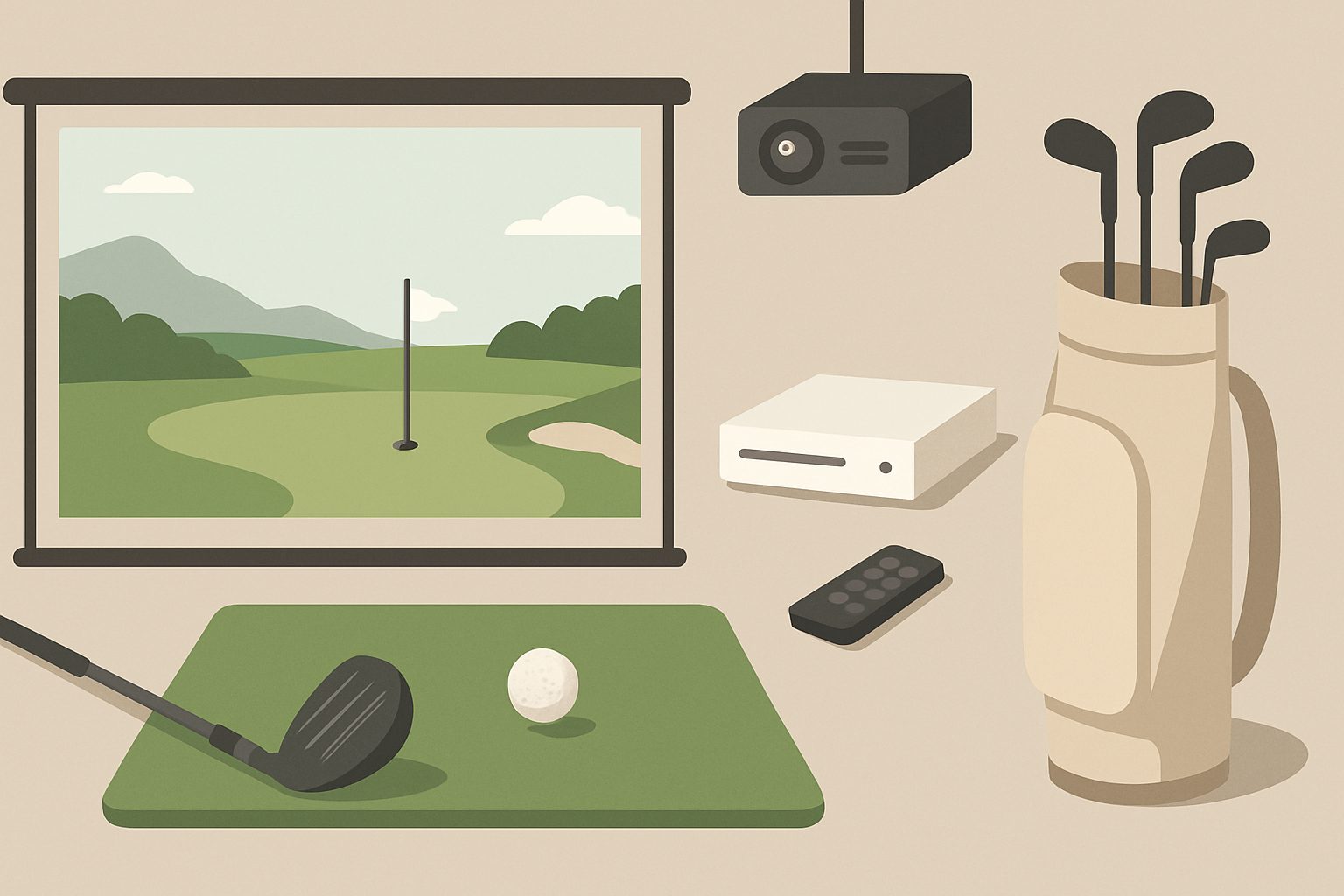
Setting up a home golf simulator in the UK comes with a unique challenge: daylight. Unlike dedicated golf studios, most home garages and spare rooms get natural light, which kills standard projectors. That's why short-throw and ultra-short-throw projectors have become essential for anyone serious about a realistic simulator setup at home.
The projector is the second-biggest expense after your launch monitor and software, but it's equally critical to the experience. A dim projector on a small screen won't do justice to your swing feedback or make practice enjoyable during winter mornings or afternoon sessions.
Why Short-Throw Matters for UK Garages
A traditional projector needs 2.5 to 3 metres distance from your screen to display a proper impact area (the ball-flight window on your launch monitor). Most UK garages and converted spare rooms are 4 to 5 metres deep, leaving you nowhere to stand comfortably.
Short-throw projectors sit just 0.5 to 1.5 metres from the screen, solving this space problem entirely. Ultra-short-throw models sit even closer—sometimes just 10-15cm away. This lets you fit a full simulator setup into tight spaces without cutting back on screen size or image brightness.
The trade-off is brightness. Short-throw designs lose some lumens compared to standard long-throw projectors. That's why brightness (measured in ANSI lumens) becomes your primary specification when shopping for daylight use.
Brightness Requirements for Daylight Use
Aim for at least 3,000 lumens if your garage has windows or skylights. If you can fully blackout the room, 2,500 lumens works. Most golf simulator software (E6, TrueGolfer, Uneekor) displays the ball flight against a fairly bright background, so a dim projector makes the image look washed out even in dimmed rooms.
Contrast ratio (the difference between black and white) also matters—golf software has fine details like tree shapes and fairway contours that disappear on low-contrast projectors. Look for native contrast of at least 10,000:1.
Optoma EH412: The Standard Workhorse
The Optoma EH412 is the most commonly installed projector in UK home simulators, and for good reason. It delivers 4,500 lumens, 10,000:1 native contrast, and works well with short-throw mounting arms (throw ratio 1.23:1 to 1.48:1).
The image is bright and punchy without being overly saturated. Colours stay accurate, which matters for reading course maps and greens graphics. Its 1080p native resolution isn't 4K, but at typical screen sizes (130-150 inches), the pixel density is fine. The lens focus and zoom control are smooth, making image adjustment straightforward.
Runtime on the lamp is rated at 5,000 hours, and replacement lamps are widely available and reasonably priced in the UK. The projector runs warm and will need active cooling in a small garage—fan noise is audible but not intrusive during shots.
Drawback: the EH412 is now ageing. Newer competitors offer better features, though the EH412 remains reliable and performs the job well.
BenQ LH730: Brighter, Sharper
BenQ's LH730 steps up to 5,000 lumens and native 4K resolution, with laser light source instead of a lamp. The brightness advantage is noticeable in semi-lit rooms, and the laser engine produces more consistent colour output over time (lamps dim gradually).
The throw ratio is similar to the Optoma (1.35:1), so mounting flexibility is comparable. Native 4K helps with fine details in golf software, especially if you're displaying swing data or course overlays. Contrast sits at 10,000:1.
The main cost is upfront price—roughly 40% more than the EH412. Maintenance is lower (lasers don't need lamp replacements), but the initial investment is steeper. Fan noise is also slightly higher, though still manageable.
For UK setups with some ambient light, the BenQ's extra brightness is genuinely useful. If your garage has windows and you want to practise during daylight, the jump to 5,000 lumens feels significant compared to 4,500.
Epson EF-12: Compact Ultra-Short-Throw
The Epson EF-12 is an outlier: truly ultra-short-throw (0.49:1 throw ratio), meaning it projects a large image from just 30-40cm away. This is brilliant if you have a small space or want the projector mounted directly above your hitting area.
At 2,000 lumens, it's dimmer than the Optoma and BenQ, so it requires good blackout. But in a dark room, the 40,000:1 contrast ratio delivers stunning depth—golf software looks crisp and dimensional. Native 1080p resolution is fine at moderate screen sizes.
The catch: you'll need to fully blackout your space. If you have any daylight, this projector struggles. It's best suited to converted basements or heavily curtained rooms. Also, mounting it so close to the swing path requires careful planning to avoid damage.
Which One to Choose?
Best for most UK garages: The Optoma EH412 remains the safest choice. Proven reliability, bright enough for semi-lit spaces, affordable, and parts are easy to find locally.
If you have windows and want maximum daylight flexibility: The BenQ LH730. The extra 500 lumens and laser engine justify the cost if natural light is unavoidable.
If space is your bottleneck: The Epson EF-12, provided you can fully blackout the room. No other projector fits a quality golf simulator into such tight corners.
All three will last years with proper cooling and maintenance. Pick based on your room's light situation and available space—that's what actually determines your experience.
More options
- Garmin Approach R10 Golf Launch Monitor (Amazon UK)
- SkyTrak+ Golf Launch Monitor (Amazon UK)
- Golf Simulator Impact Net & Enclosure Kit (Amazon UK)
- Golf Simulator Hitting Mat (Amazon UK)
- Short-Throw Projector for Golf Simulator (Amazon UK)